The Largest Solar Panel Farms in the World: Solar power is also one of the world’s fastest growing sources of new energy. Solar panel farms are becoming crucial infrastructure as nations pursue net-zero goals and energy independence. It’s not just the size that is jaw dropping about these projects, but what they represent: a global move toward clean, renewable electricity on an industrial scale.
In countries across Asia and the Middle East, there are some solar farms that generate more power than more traditional coal or gas plants. Instead of smokestacks pumping millions of tons of carbon dioxide into the air, they depend on millions of photovoltaic panels spread across deserts, plains, and open range. Here, then, are the biggest solar panel farms in the world by capacity and why each matters as a component of the global energy transition.
In This Article
List of Largest Solar Panel Farms in the World:
- Gonghe Talatan Solar Park, China
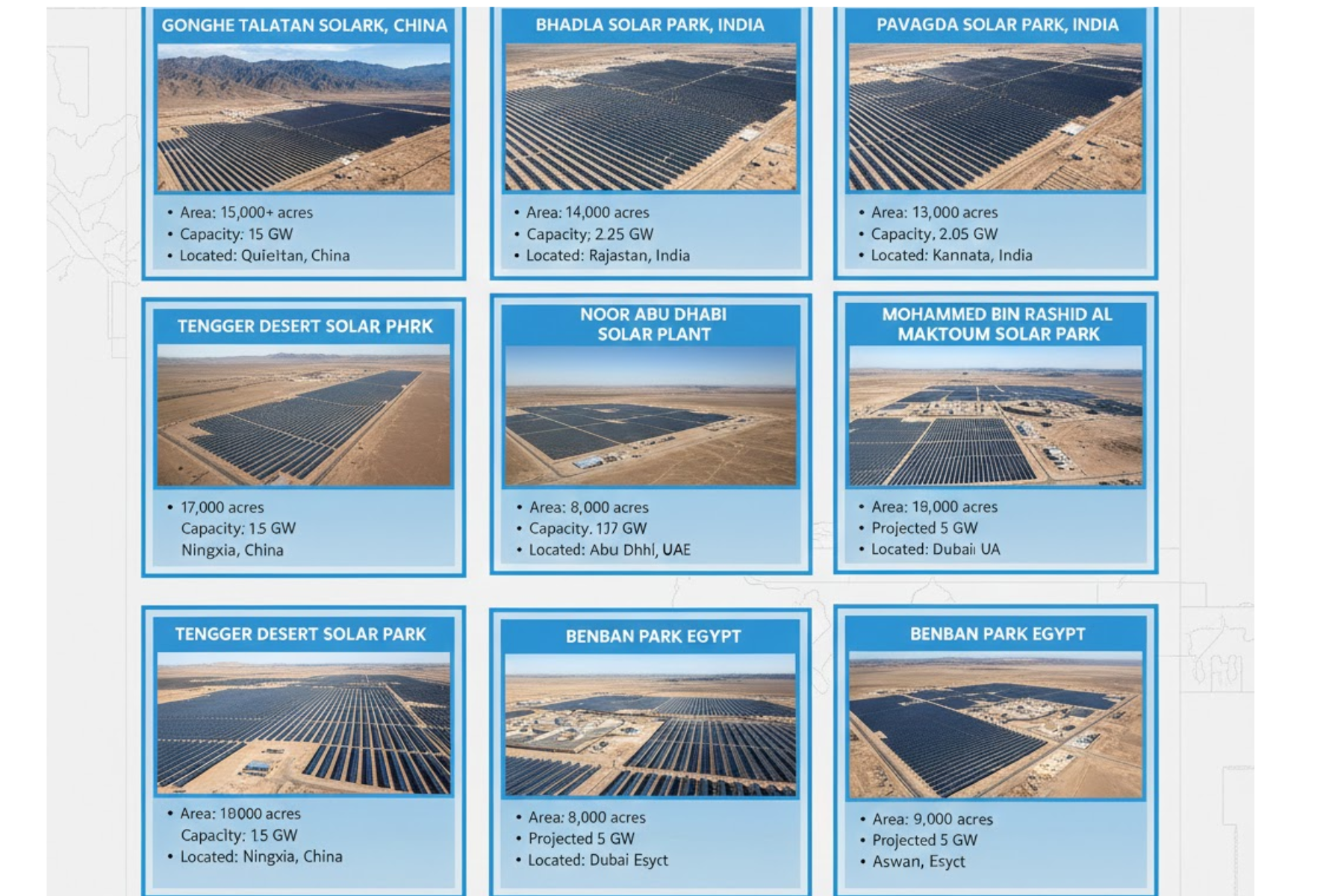
The Gonghe Talatan Solar Park is one of the biggest solar projects ever built and is based in Qinghai Province, China. This massive project spans over 15 gigawatts of installed capacity and is one of the most potent solar sites on the planet. Its sheer size is an indication of China’s bold commitment to renewables and long term energy security.
The park is situated on a vast expanse of high-altitude land with intense sun and little shade. It also forms a substantial part of the generation mix that provides clean electricity to regional grids with lower reliance on coal fired generation. Gonghe Talatan is further evidence of how solar can work at scales previously thought impossible.
-
Bhadla Solar Park, India
Bhadla Solar Park is among the most popular big solar farms found across the world in the Rajasthan desert. With a capacity of more than 2 gigawatts, the plant has played a role in helping India become a power player in renewable energy. The heat-wave and the bright light of the desert, which were, until recently, merely a hindrance, now offer a strong advantage.
Bhadla has shown that large-scale solar farms can be constructed fast and cheaply, even in difficult terrains. Its success has paved the way for more solar investment throughout India, where it is trying to amplify renewable energy use and provide electricity to a growing population.
-
Pavagada Solar Park, India
Another Indian mega solar project, the Pavagada Solar Park in Karnataka, spans thousands of acres and has a capacity exceeding 2 gigawatts. Unlike most government-owned land projects, Pavagada is a land lease model, which can help keep local farmers financially stable but still own the right to their property.
This new kind of model for developing community-owned renewables has established the project as a beacon with regard to socially responsible renewable projects. And it underscores how solar farms can bring economic benefits, along with clean energy, especially in rural communities.
The Largest Solar Panel Farms in the World
-
Tengger Desert Solar Park, China
The Tengger Desert Solar Park, also known as the “Great Wall of Solar,” is being built in northern China and will stretch for miles across the desert floor. The installation has a capacity to generate over 1.5 gigawatts, making it one of the largest contiguous solar projects in the world.
The project demonstrates how non arable desert can be developed into an asset for providing energy. It also underscores China’s proven capabilities in rapidly rolling out renewable energy at scale, with standardised designs and robust grid integration.
- Noor Abu Dhabi Solar Plant, United Arab Emirates
The Noor Abu Dhabi solar plant is the world’s largest single site solar project. Noor Abu Dhabi is one of the world’s largest single site solar plants outside Asia, rated at 1.17 gigawatts. The project, which is based in an area traditionally endowed with oil and gas, marks a clear step towards green power in the Middle East.
- The Mohammed bin Rashid Al Maktoum Solar Park – UAE
The Mohammed bin Rashid Al Maktoum solar park in Dubai, still under development (Phases), is soon going to be the largest Solar Park in the World. Planned capacity amounts to several gigawatts by integrating photovoltaic panels with concentrated solar power.
This combination enables the plant to produce electricity after dark, when solar power cannot be produced. It is a shining example of the future of big solar, with storage and smart technology being used together to deliver power even when the sun isn’t shining.
-
Benban Solar Park, Egypt
Benban Solar Park, in southern Egypt, is one of the biggest solar developments in Africa. Having a combined capacity of almost 1.6 gigawatts, it has turned the area into a regional hub for renewable energy.
It is a cluster of several interconnected solar plants that supply the grid with clean energy. Benban has also lured international investment and led to the creation of thousands of jobs, showing how solar power can help stimulate economic expansion in the developing world.
Why These Solar Farms Matter
These enormous solar panel farms are not just engineering feats; they are changing global energy systems. Combined, they produce tens of gigawatts of clean electricity, displacing fossil fuels and cutting greenhouse gas emissions on a vast scale.
Big solar farms also help to stabilise energy prices by generating steady supplies of low-cost electricity once built. And they have an increasingly important role to play as battery storage and smart grid technologies continue to advance.
Challenges of Utility-Scale Solar
But large solar farms take a few lumps in return for all those benefits. Acquisition of land, grid connectivity and ecological constraints must be effectively dealt with. It also depends on weather patterns and the time of day, so long term reliability requires storage and flexible grids.
But improvements in technology and preparation are still overcoming these hurdles. There are also a growing number of hybrid systems that combine solar with storage or other renewables.
What’s Next for the World’s Biggest Solar Farms
The following list consists of the world’s largest solar panel farms and this list will change as this wonderful technology advances. With the ongoing decrease in prices and increasing efficiency, new projects are likely to break today’s records. Floating solar farms, desert mega-projects and wind turbines at sea are all part of the surge in next generation power that’s changing how we generate electricity.
What we know is that solar power has graduated from the fringes to the mainstream. Such giant solar farms are proof that renewable energy can work on the scale needed to power modern economies.
FAQs: The Biggest Solar Panel Farms in the World
Ques. What makes a solar farm one of the largest in the world?
Ans. Solar farms are most often rated by capacity, in gigawatts. Under perfect natural conditions, the more MW capacity (not physical land size) a site has means it can generate more electricity.
Ques. Is it true that the biggest solar farms are always in deserts?
Ans. Not all the time, but deserts do provide good sunshine and plenty of open space, along with fewer constraints on building permits. But big solar farms are also sprawled across the plains, farmland and former industrial sites.
Ques. How long does it take to construct a gigantic solar farm?
Ans. Construction times differ, but many big solar farms are constructed in stages over a number of years so that parts can start earning money by pumping out electricity while the growth continues.
Ques. How much do large solar farms require energy storage to be effective?
Ans. Storage is not always necessary, but it significantly increases reliability. Batteries create the ability to store daylight energy for use at other times, which smooths the churn of solar power.
Ques. Are solar farms more expensive than fossil fuel power plants?
Ans. Over their lifetime, large solar farms are also often cheaper because they have no fuel costs and low operating expenses making them more competitive with traditional power generation. Solar by itself isn’t going to eliminate the need for fossil fuels, but factored along with wind, storage, and other renewables, it’s an important part of moving away from carbon based sources of energy.