How Does a Solar PPA Work in the UK: A Simple Guide For Businesses in the UK
The cost of electricity is unpredictable in the UK, and with greater pressure coming from sustainability targets, many are searching for methods to better manage their electricity costs. One of the solutions that is seriously picking up steam is the Solar Power Purchase Agreement (Solar PPA). If you’ve heard the term and not been quite sure how it works, or whether there’s an upside to it for your business, you’re not alone. In this article, we will delve into how a Solar PPA works in the UK, as well as why companies are engaging with the agreement and what it can provide without capital outlay.
Instead, let’s make it basic, practical, and focused on business.
In This Article
What Is a Solar PPA?
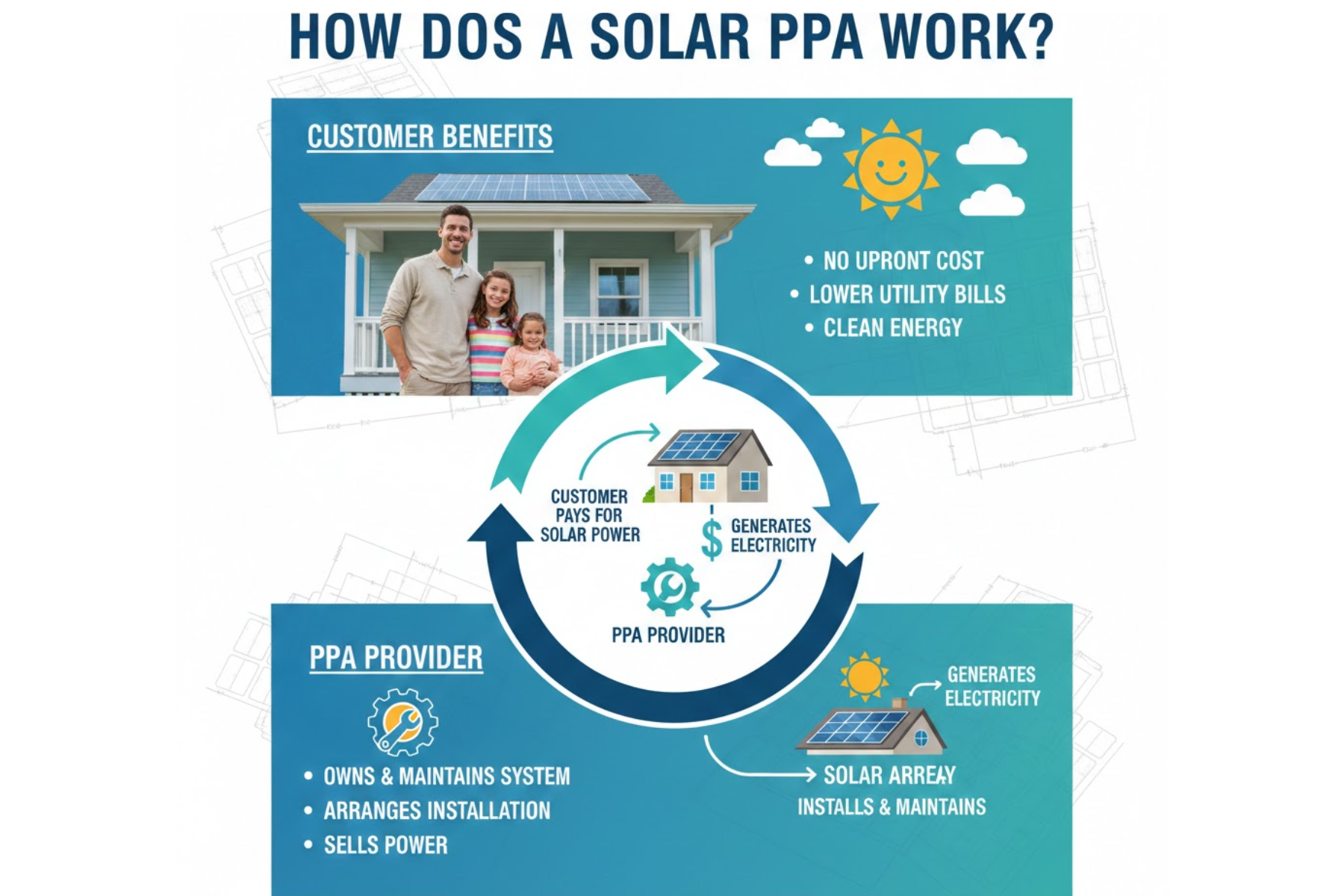
A Solar Power Purchase Agreement (PPA) is a long-term contractual agreement between a business and a solar energy provider. Under this agreement:
- A solar developer funds, owns, and operates a solar PV system on your property.
- Your company pays for the electricity produced by the panels at a fixed, pre-agreed-upon rate.
- You’re not paying for the solar panels upfront.
In other words, you receive clean, renewable power at a set price, and the solar company handles everything else.
Why do solar power purchase agreements (PPAs) continue to grow in the UK?
The UK energy market has undergone huge changes over the last few years. With soaring electricity costs, rising grid congestion, and the rapidly evolving net-zero age, Solar PPAs have seen increasing appeal from commercial and industrial businesses. Companies are adopting PPAs to shield themselves from potentially volatile energy prices, decrease dependence on the grid, defer issuance of capital expenses, and take a significant step toward sustainability and ESG targets. For a large number of companies, solar PPA is not just an energy decision, but the business and financial matters also become critical.
How Does a Solar PPA Work in the UK?
The assessment develops, in the first instance, from an initial feasibility study and a detailed site appraisal. The solar provider considers factors such as available roof or land area, structural compatibility, electricity consumption, and grid connection capacity, shading, or orientation. This phase is used to ascertain if the site can generate sufficient solar to execute a PPA. Specialist suppliers like Arc Renewables help companies during this early stage by providing specialist consultancy and feasibility studies. Arc Renewables serves corporations, private landlords, public sector organizations, and Commercial/rural clients throughout the UK with a specialism in commercial roof space and agricultural solar installs.
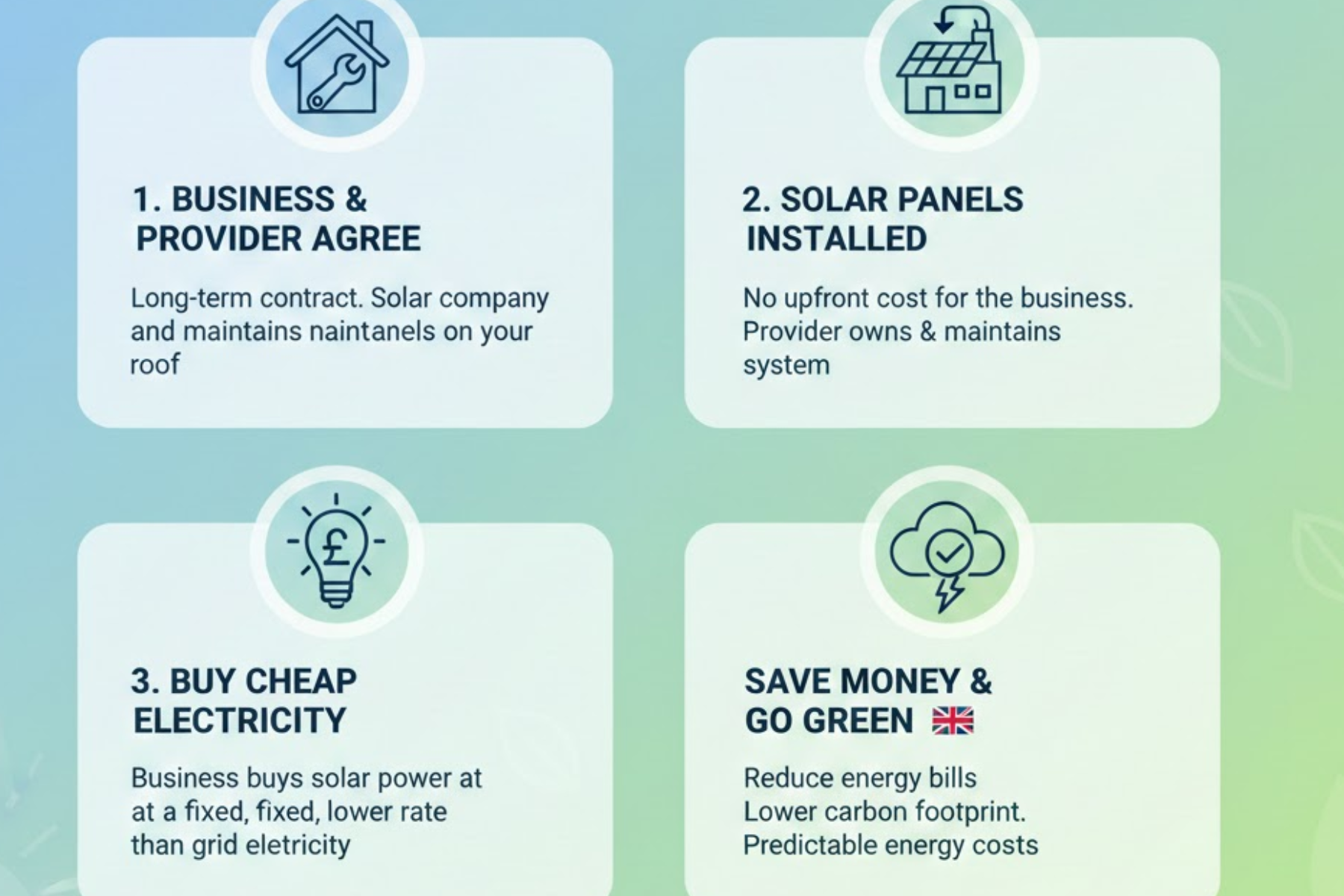
When a location is approved, the installer submits a Solar PPA proposal. For example, this agreement will lay out the length of the PPA (which typically runs from 10 to 25 years), the price per kilowatt hour, estimated production, and a performance warranty. The tariff paid is usually less than the standard grid tariff and ensures long-term savings against future energy rate hikes.
Installation of Solar PPA in the UK
Once the contract is signed, the system is engineered and installed. The solar company designs a system based on the business’s electricity usage and takes care of all permits, grid approvals and regulations. Deployment disrupts your operations as little as possible. The provider assumes all the costs of equipment and installation since it owns the system. As a full turnkey provider, Arc Renewables takes care of every aspect of design and consultancy to project management and delivery.
Solar panels generate electricity for use during the day when they are up and running. All this power is consumed on-site by the business, so there’s less electricity to buy from the grid. If more electricity is needed, regular electrical power from the grid remains available as before. Businesses only pay for the solar electricity they consume, so it’s easy to track and manage how much is being used thanks to smart metering.
All of the solar provider’s operations and maintenance are consistent. This encompasses monitoring, preventative maintenance, repairs, insurance, and regulatory compliance. Therefore, there is no extra operating expense for the company. As well as being Arc Renewables, we offer ongoing maintenance and performance management so that these systems are still running effectively over the life of the contract.
At the termination of the PPA term, companies generally have some choices. They will either opt to continue the agreement (usually at a discounted rate), buy out the solar system at a discount, or ask for removal of the system. In reality, the vast majority of businesses choose to leave it installed because, by now, long-term savings and energy usage are low.
Types of Solar PPAs in the UK
In the UK, there are broadly two types of Solar PPAs. On-site Solar PPAs are where a solar system is installed, say on the roof or land of your business, and the energy it generates is consumed at that location. This is the ideal model for factories, warehouses, office shops, and retail sheds, as well as farm buildings. Offsite or virtual Solar PPA’s refers to electricity being produced from a separate solar farm with financial settlement instead of direct consumption. These types of setups are more likely in the case of large companies or where there is more than one location.
Who Can Get The Most Out of a Solar PPA?
Solar PPAs are particularly pertinent for businesses with large daytime electricity loads. This comprises factories, warehouses and logistics facilities, retail chains, commercial buildings (ie offices), data centres, educational institutions, healthcare operations and farms. Where daytime energy usage is high, it can lead to significant savings in cost and carbon achieved by taking a Solar PPA.
Paying no up-front capital for their solar power system is one of the greatest benefits of a Solar PPA. Companies don’t have to pay for equipment, installation, or checks. Electricity prices are usually reduced compared with the standard grid tariffs, and a fixed-rate tariff offers long-term price security. And, because it doesn’t affect capital budgets, companies also experience immediate savings and cash flow.
Environmental and ESG Advantages
Solar PPAs are as much about physical savings as they are about intangible environmental and ESG advantages. They cut carbon emissions, deliver on their net-zero targets, and can report more favourably in terms of sustainability once they have made the move. Showing a dedication to sustainable energy can also help boost brand reputation and investor confidence in an ever-more green-obsessed marketplace.
Risks and Considerations
Solar PPAs have many benefits, but there are several considerations to take into account. These considerations include the length of the contract, the state and ownership of the roof or land, credit criteria, and expected changes in electricity demand. A reliable and experienced supplier, like Arc Renewables, will transparently address these considerations to make certain the solution meets your business’s long-term goals.
Does a Solar PPA Make Sense for Your UK Business?
Businesses looking to lower energy costs without any upfront capital, enhance their sustainability profile by reducing carbon emissions generated from electricity consumption, can look at a solar (PPA) Power Purchase Agreement and get the long-term price certainty in an environment of volatile and rising electricity prices. With the right partner, it can be a lucrative path to renewable energy.
Final Thoughts
A Solar PPA provides UK businesses with a low-risk, high-reward path to renewable energy. “It takes away the up-front costs of solar and provides immediate savings and locking in long-term rates. With reputable experts like Arc Renewables offering consultancy, design, project management, and long-term maintenance throughout the UK, businesses have no reason not to follow suit, particularly in sectors such as commercial rooftop and agricultural. As the power market changes, so too do Solar PPAs offer a viable, enduring, and cost-effective path for businesses to stay ahead of the curve.
Frequently Asked Questions (FAQs)
Ques. How long is a Solar PPA in the UK?
Ans. The average duration for a Solar PPA in the UK can range from 10 years to 25 years. This long-term arrangement enables business owners to secure lower electricity prices and enjoy savings in a steady manner over the years.
Ques. Do I have to be a property owner to enter into the Solar PPA?
Ans. Not necessarily. Businesses can also use Solar PPAs on leased properties, as long as they have their landlord’s (the property owner’s) permission and their lease duration is equal to the term of the PPA.
Ques. Is solar energy viable in the UK weather?
Ans. Yes. Today’s solar systems are also capable of functioning effectively in overcast conditions, and the UK has enough heat and sun to make solar work for you all year round!
Ques. What if my energy consumption changes?
Ans. Solar PPAs are flexible. You still use grid power as well as solar, so shifts in usage don’t affect operations or supply.
Ques. Who covers repairs and maintenance?
Ans. Your solar provider takes care of all maintenance, monitoring, and repairs, ensuring the system is running efficiently without any additional work or costs for your business.
Ques. Can a Solar PPA contribute to your ESG and net-zero targets?
Ans. Absolutely. Solar PPAs enable businesses to decrease their carbon footprint by a significant amount and assist in the alignment with corporate sustainability, ESG, and net-zero goals without the need for large capital expenditure.