

How to Install Commercial Solar Panels: A Step-by-Step Guide for UK Businesses: Rising energy prices and volatile electricity tariffs are pushing UK businesses to adopt more sustainable practices. As a result, more and more people are thinking about getting commercial solar panel installation for their environmental as well as monetary benefits. A commercial solar power system can mean a lot less for businesses to worry about when it comes to utility costs and stressing over what that means for the future.
But the installation of commercial solar tubes can appear to be a little bit complex, involving initial evaluations, permissions, grid connection and financial decision-making. If you can see the whole process from plan to install, it is a lot easier.
Arc Renewables partners with businesses, private landlords, public sector organisations and private clients in the UK to give them expert advice and project management of renewable energy projects. Specialising in commercial rooftop and agricultural solar, the team provides full turnkey solutions from consultation and system design to project management and ongoing maintenance.
In reality, Arc Renewables enable commercial companies and property owners – including some of the leading UK and European commercial real estate holders and occupiers – to navigate their often complex journey to net zero. This ranges from advising clients in their decision-making-processes, to accessing financial support, complying with regulations and maximising long-term energy performance.
From the inception of your project to its completion, Arc Renewables will place highly experienced installers on site, ensuring solar projects are delivered safely, on time and cost-effectively with high financial and environmental yield.
The reasons behind the UK businesses’ investment in commercial solar panels are:
Different industry research indicates that a commercial solar system can help businesses reduce electricity costs by 30-60%. Industry research indicates that commercial solar systems can reduce electricity costs by 30–60%. According to EdenSustainable, the typical payback period for a commercial solar installation is around 5–7 years.
The first thing you need to figure out is if your house can accommodate solar. This requires conducting an energy and site audit. Key considerations include:
The best places for commercial solar panels are as follows:
This assessment serves as the blueprint for a customised system design to meet your energy requirements and business objectives.
After the site suitability determination, a system design and feasibility analysis must be conducted. This stage includes:
Summary of financials — expected savings and payback duration
The feasibility report confirms that the system is technically viable, UK standardised and financially sound.
The majority of commercial solar installations (not being erected on domestic premises, unless agricultural or part of a public body) don’t need planning permission, but do require checking for compliance. You might need ‘planning permission’ if:
Compliance checks should include:
Applying for connection to the National Grid Prior to installation, businesses need to apply for connection to the National Grid through their Distribution Network Operator (DNO). The DNO evaluates:
The time taken to receive a connection approval differs from one system, depending on the complexity or level of DNO workload; hence, it is crucial that you apply in good time.
Please note that there is no UK national solar grant for businesses, but there are some funding options:
And organising some financing before installation does make for an easier project completion.
Installation So once you have approvals and funds, the installation process can start. Typical steps include:
Commissioning is usually completed over one to three weeks, depending on the size and complexity of the system.
The system still needs to be commissioned after installation. This involves:
Once installed, the system starts producing clean power for the company.
Monitoring ensures optimal performance. Maintenance could consist of yearly inspections, inverter maintenance and fault finding. Most solar panels last 25-30 years so it can be a less risky long-term investment.
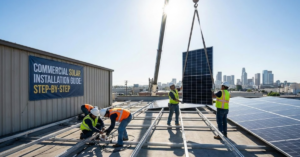
A Quick Glance at the Installation Timeline for Commercial Solar Panels:
| Stage | Typical Duration |
| Initial assessment | 1–2 weeks |
| System design | 1–2 weeks |
| Planning & grid approval | 4–8 weeks |
| Installation | 1–3 weeks |
| Commissioning | 1–2 weeks |
What are the Common Mistakes to Avoid for Installing Commercial Solar Panels?
Some common mistakes to avoid:
By partnering with Arc Renewables, you can help your business avoid these pitfalls.
Are Commercial Solar Panels Worth It?
Yes, even without grants, commercial solar panels can offer:
Arc Renewables can support businesses in making the financial and environmental case for solar. Our experts can ensure projects are visible and cost-effective.
Q1: How long does it take to install commercial solar panels?
Ans. Installation usually occurs in 1–3 weeks, but the preparation (a certain evaluation, design and approval) can be done in 2–3 days.
Q2: Is planning permission required?
Ans. The majority of installations on commercially used buildings are permitted development and therefore do not require planning permission. There may be a requirement for consent in respect of listed buildings, conservation areas or large ground-mounted installations.
Q3: Are solar panels available for rental properties?
Ans. Yes, with landlord approval. With a variety of options such as Power Purchase Agreements (PPAs) or lease arrangements, initial costs can be minimised.
Q4: Will the business be interrupted in any way during the implementation of the lease?
Ans. Fit-out is typically of low impact as a lot of the work is carried out externally and programmed outside business hours.
Q5: What power do commercial solar panels have?
Ans. Power generation is a function of capacity and roof area. Most commercial programs supply 30–60% of the annual electricity load.